
PROMO PHYSICS™
D2C promotions category has a measurement problem. Here’s what it’s costing you
On the Promo Dark Matter hiding in your promotional economics — and the invisible toll it takes on margin, cohorts, and growth.
By Sanchin D Raj, Founder & Principal, HIF Analytics
March 6, 2026
The same room, two different conversations
Picture a quarterly promo review. The CFO and CMO are in the same room, looking at the same slides.
The CFO sees a margin line that moved in the wrong direction. She sees promotional spend that grew faster than revenue. She sees a number she’ll have to explain to the board.
The CMO sees a campaign that drove a 34% lift in orders. He sees new customers acquired at a cost that beat last quarter. He sees momentum.
Neither of them is wrong.
But they are not having the same conversation — and they probably never will, as long as D2C promotions are measured the way most brands measure them today: optimized for the metric that’s easiest to report, not the one that actually reflects what a promotion did to the business.
That gap is unnamed. Call it the Promo Dark Matter — the costs most brands can’t see with conventional measurement tools, compounding quietly until they show up somewhere no one expected.
The reasons run deeper than most brands realize — and they compound each other. The problem isn’t how brands are running their promotions. It’s how the entire measurement system was built.
The first is that the D2C channel grew faster than the tools built to measure it. Trade promotion frameworks were designed for retail — for slotting fees, shelf placement, and distributor margins. When brands began selling directly to consumers, they carried those frameworks with them. They fit imperfectly at best. At worst, they measure the wrong things entirely.
The second is that the metrics most brands rely on were chosen for their convenience, not their accuracy. ROAS is easy to pull. Redemption rate is easy to report. Revenue lift looks good in a deck. But none of them tell you what a promotion actually did to the customer relationship — whether it brought in buyers who would have purchased anyway, whether it trained your best customers to wait for a discount, or whether the margin you gave up in October is still affecting your P&L in March.
Seasonality makes this worse. A promotion that runs in November will almost always show a lift — because November was going to be strong regardless. The discount gets the credit. The decision to repeat it gets made. And the brand never discovers how much of that result it would have captured for free. Organic demand peaks are one of the most consistently misread signals in D2C promotional measurement, and almost no brand at this scale is correcting for them.
The third — and the one least often discussed in a boardroom — is that finance and marketing are not working from the same definition of success — and have no shared scorecard to resolve it. They have different incentives, different success metrics, and different time horizons. Finance is protecting margin. Marketing is building pipeline. Both are legitimate goals. But without a shared framework to evaluate promotional decisions, they end up optimizing against each other — and the business pays the difference.
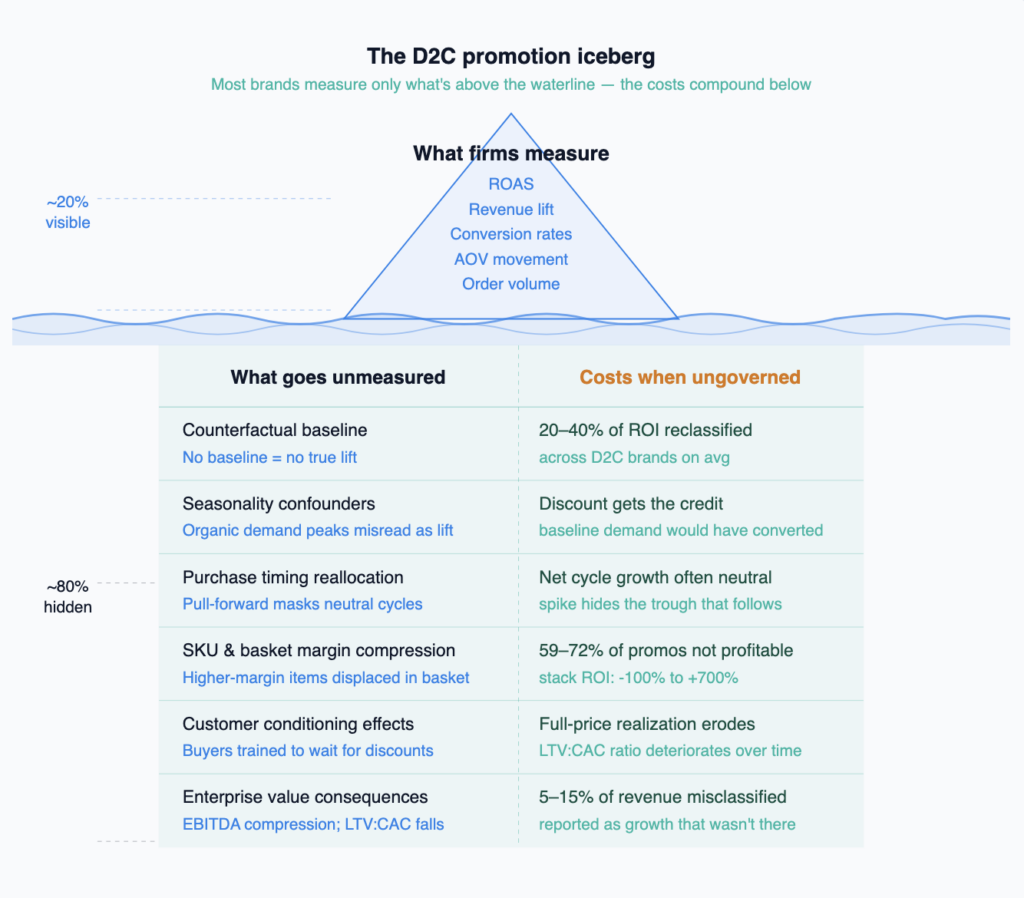
What gets measured, in most D2C brands, is the visible part. The campaign results. The top-line lift. The numbers that fit on a slide.
What goes unmeasured is everything below the waterline
What the gap is actually costing D2C brands
This isn’t a theoretical problem. The Promo Dark Matter is already showing up in the economics of D2C businesses — in acquisition costs that have quietly outpaced order values, in margin compression that doesn’t appear until a quarter after the campaign, and in the slow erosion of customer relationships that once looked healthy on a dashboard.
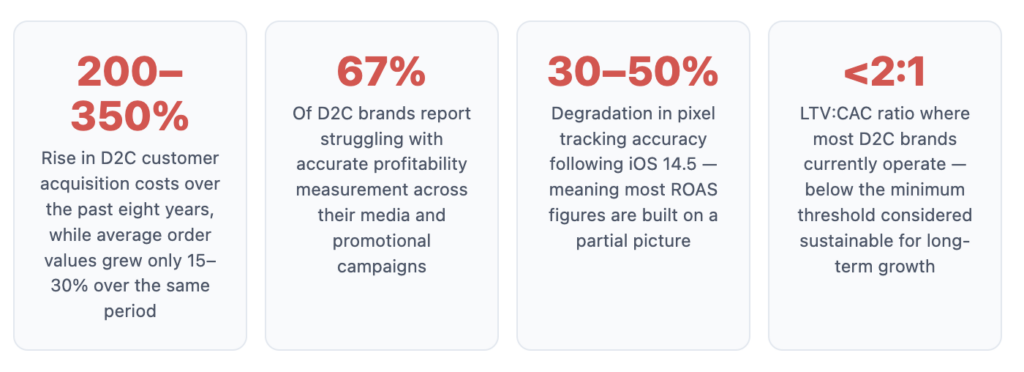
Each of these numbers reflects a different dimension of the same underlying problem. Acquisition costs have risen because brands are competing harder for attention in channels where measurement has simultaneously become less reliable — a particularly dangerous combination. iOS 14.5 didn’t just degrade attribution data; it degraded the confidence with which promotional decisions are made, without most brands acknowledging that it had.
The cost of acquiring a D2C customer has grown 7 to 20+ times faster than the average value of what customers actually buy — severely compressing unit economics over eight years. Aggressive promotional strategies compound that pressure further. Discount-conditioned customers don’t just cost more to acquire. They cost more to retain, they buy less at full price, and they churn faster when a better offer appears elsewhere.

What a promotion actually does to your business
Rising digital advertising costs compound this further. The cost of reaching 1,000 people online — once $8–12 — now regularly runs $25–50 or higher. Every promotional campaign launched into that environment carries a higher floor cost before a single discount is applied. And yet the frameworks most brands use to evaluate those campaigns haven’t kept pace — they still measure what happened during the campaign window, not what the campaign did to the underlying economics of the customer base it reached.
Here is what most D2C brands are missing.
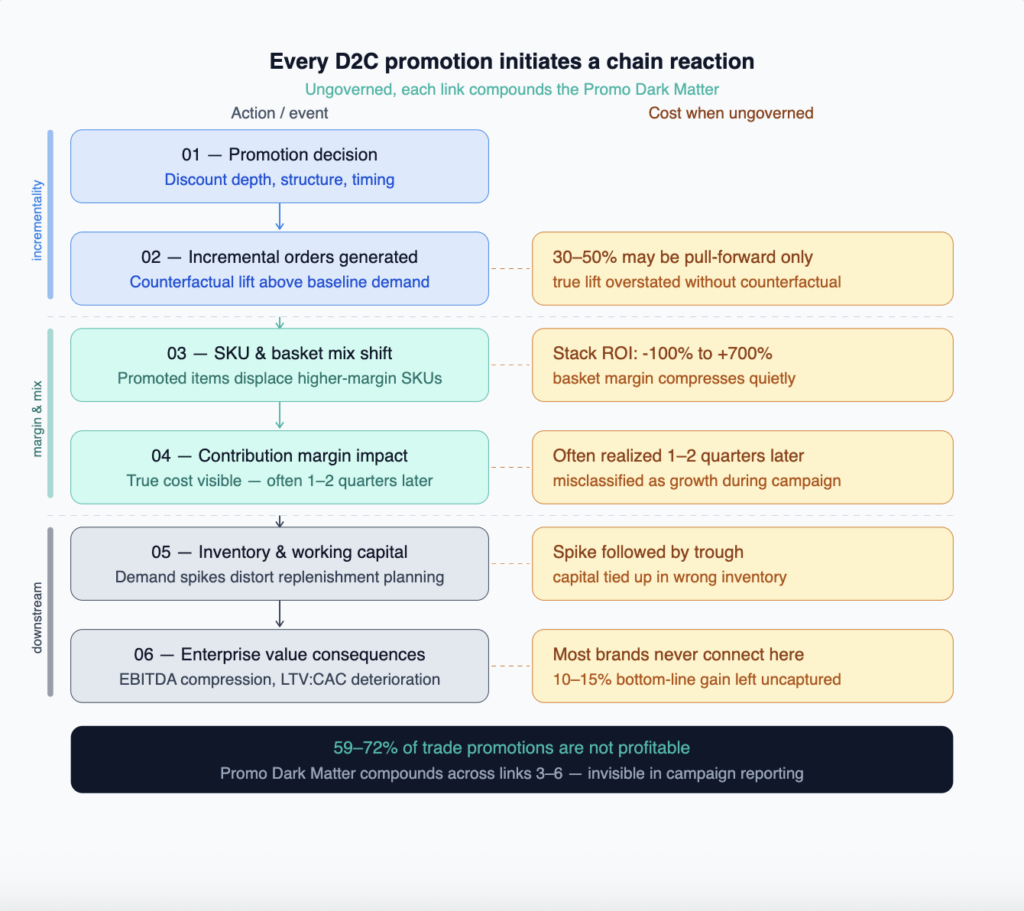
A promotion is not an event. It is a decision that travels through your business — touching margin, shaping customer behavior, influencing repeat purchase rates, and ultimately showing up in the metrics that determine how your company is valued. By the time its full effect is visible, the team that ran it has already moved on to the next campaign.
Think of it as a chain. A promotional decision triggers a price signal. That price signal shapes who buys and why. The mix of customers it attracts determines the cohort’s lifetime value. The cohort’s behavior over the following quarters affects contribution margin. That margin profile influences how capital gets allocated. And capital allocation, compounded over time, is what separates a D2C brand that scales from one that stalls.
Six links. One decision. Most brands are only measuring the first.
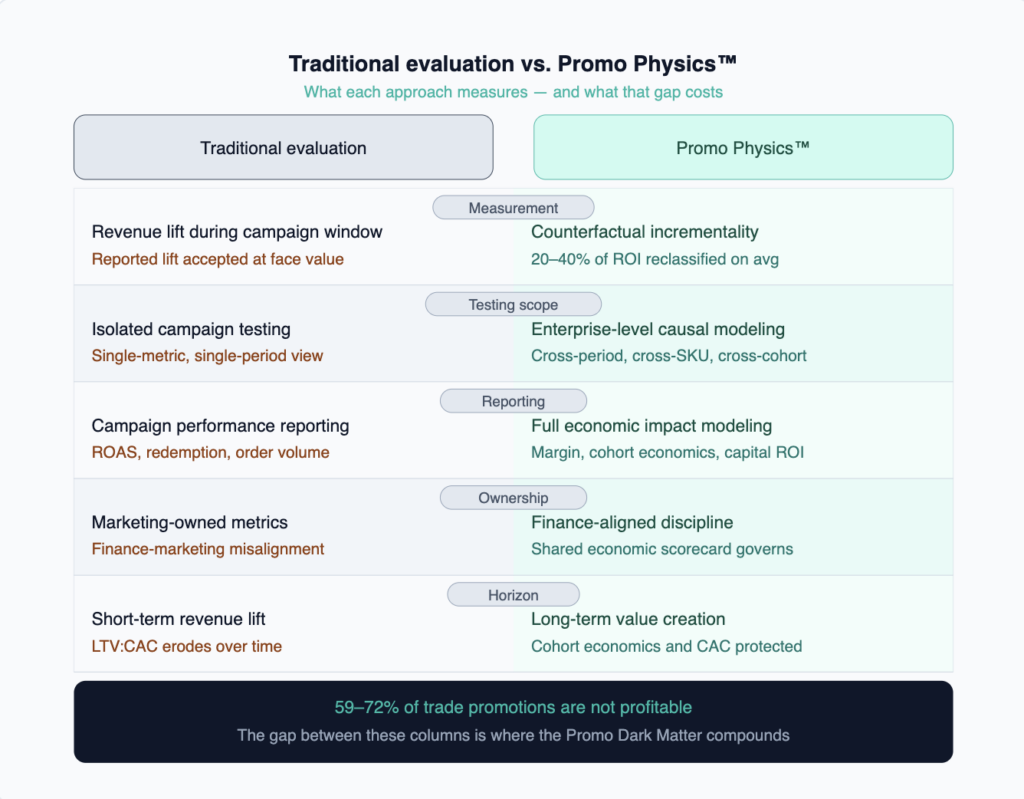
This is the problem Promo Physics™ was built to solve. Not as a reporting tool, and not as a way to produce better-looking dashboards. As a framework that applies the rigor of financial modeling to the behavioral dynamics of D2C promotional strategy so that the people making promotional decisions are working from a complete picture, not a convenient one.
The difference between traditional promotional evaluation and Promo Physics™ is not complexity. It is completeness. Traditional evaluation asks: did this promotion work? Promo Physics™ asks: what did this promotion actually do to the business and what will it do next quarter, and the one after that?
That distinction is the waterline
Three questions worth answering before your next promo review
Before the next promo review, three questions are worth sitting with.
The first: do you know your true promotional margin — not the revenue lift from the campaign window, but the margin effect across the following two quarters, accounting for the customers that promotion attracted and how they behaved afterward? If the answer requires a conversation between finance and marketing that hasn’t happened yet, that’s the gap.
The second: can your finance and marketing teams agree, before a promotion runs, on what success looks like? Not after the results come in — before. If the answer is “it depends who you ask,” you don’t have a measurement problem. You have a framework problem.
The third: are you optimizing for what matters, or for what’s easy to measure? ROAS is easy to pull. Revenue during a promotion period is easy to observe. But neither tells you what your promotion actually caused — how many of those orders would have happened without the discount, which customers it brought in for the first time versus which ones simply pulled forward a purchase they were already planning, and what the net effect was on the economics of your customer base. If those are the numbers driving your promotional decisions, you are making expensive choices on incomplete evidence.
Most D2C brands, if they are honest, will answer at least one of these with a no — or a silence that means the same thing.
That is precisely where Promo Physics™ begins.
Research basis
- McKinsey “How analytics can drive growth in consumer-packaged-goods trade promotions.” Source for 59% of CPG promotions globally losing money (72% in the United States); best-in-class promotions returning five times more than the least efficient. Also: basic lift and ROI assessments failing to account for cannibalization and pantry loading effects.
- McKinsey “The direct-to-customer edge: Increasing shareholder value through business building,” August 2023. Source for D2C companies showing 30% higher year-over-year share-price growth and 7% higher P/E multiple growth compared to non-D2C businesses. Cross-industry analysis of more than 200 companies over the period 2012–22.
- eMarketer “CPG digital ad spend surges in 2024, driven by D2C shift.” Source for CPG digital advertising spend reaching $48.79 billion in 2024; D2C channel shift identified as a primary growth driver.
- Rajiv Gopinath “ROAS vs. Profitability in D2C Media: The Hidden Truth Behind Revenue Numbers,” 2025. Source for 67% of D2C brands reporting difficulty with accurate profitability measurement across media and promotional campaigns, citing Direct-to-Consumer Association research.
- Bain & Co. Source for 5% increase in customer retention producing a 25–95% improvement in profits; existing customers converting at 60–70% versus 5–20% for new prospects. Cited via Delight, referencing Bain & Company research.
- 23HubLab “Retention-Driven Marketing for D2C Brands,” 2025. Source for D2C customer acquisition costs rising 200–350% over the preceding eight years while average order values grew only 15–30%; iOS 14 attribution degradation impact on D2C measurement.